Pain & Regenerative
Medicine
Non-surgical musculoskeletal care using shockwave therapy and platelet-rich plasma (PRP) — physician-directed, anatomy-guided, and grounded in evidence-based regenerative science.
Shockwave Therapy & PRP
If chronic pain or a nagging injury is holding you back from the activities you love, you're not alone. Regenerative medicine offers a fundamentally different approach — working with your body's natural healing mechanisms rather than just masking symptoms.
Restore Function.
Accelerate Healing.
Non-Surgical Care.
Chronic tendon pain, ligament injuries, and soft tissue degeneration are among the most undertreated conditions in medicine. Patients are often told to rest, take anti-inflammatories, or accept that surgery is the only remaining option.
At Lakewood, we offer a third path — physician-directed regenerative therapies that use acoustic energy and your body's own concentrated growth factors to stimulate genuine biologic repair of damaged tendons, ligaments, and soft tissue.
These are not symptom-masking treatments. Shockwave therapy and PRP work by activating the body's natural healing cascade — producing structural tissue repair, not temporary pain suppression.
Conditions We Treat
Chronic Tendon Pain
Persistent tendinopathy unresponsive to rest, physical therapy, or cortisone injections.
Tennis / Golfer's Elbow
Lateral and medial epicondylitis — overuse injuries of the elbow tendons causing grip weakness and pain.
Plantar Fasciitis
Heel and arch pain from degeneration of the plantar fascia — one of the most common indications for shockwave therapy.
Achilles Tendinopathy
Mid-portion and insertional Achilles pain that limits activity and fails to resolve with conservative care.
Patellar Tendon Pain
Jumper's knee — chronic patellar tendinopathy causing anterior knee pain during activity.
Rotator Cuff Tendinopathy
Shoulder impingement and partial-thickness rotator cuff injuries not requiring surgical repair.
Trigger Points & Muscle Tightness
Chronic myofascial pain, muscle knots, and referred pain patterns that limit range of motion.
Ligament Strain / Partial Tears
Partial ligament injuries and chronic ligament laxity where regenerative stimulation accelerates healing.
Technologies We Use
We offer two complementary regenerative modalities — each with distinct mechanisms and clinical indications. Your provider will determine the optimal approach based on your diagnosis, imaging, and treatment history.
Viewing: Radial Shockwave Therapy — tap "PRP for Tendon & Ligament Repair" to switch
Radial Shockwave Therapy (RSWT)
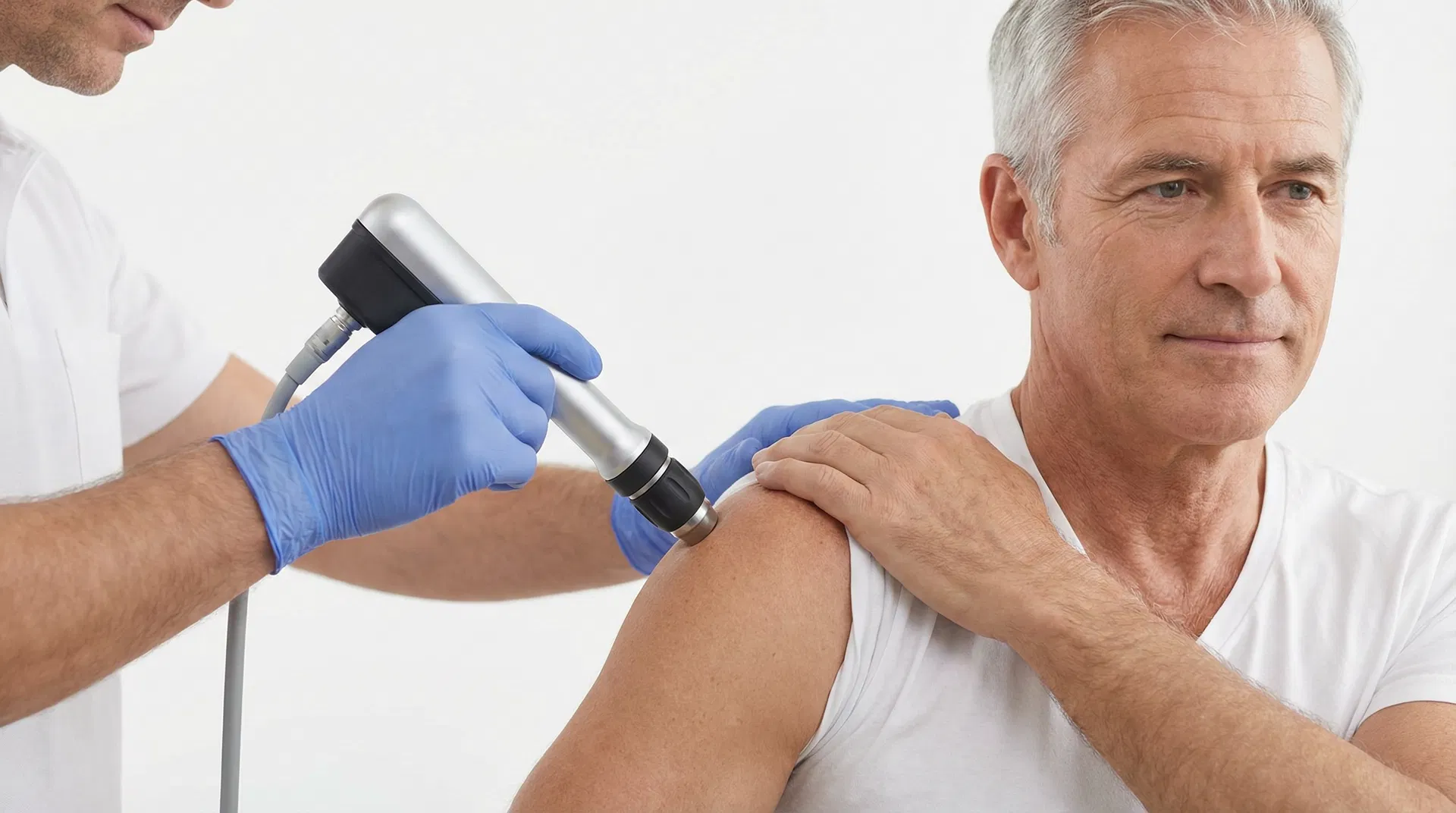
Radial shockwave therapy delivers high-energy acoustic pressure waves that spread radially from the applicator tip into the target tissue. The mechanical energy disrupts calcifications, breaks down scar tissue, stimulates neovascularization, and triggers a controlled inflammatory healing response that initiates collagen remodeling in chronically degenerated tendons.
Unlike cortisone injections — which suppress inflammation temporarily but do not repair tissue — radial shockwave activates the body's own regenerative mechanisms. It is one of the most extensively studied non-surgical treatments in orthopedic and sports medicine literature, with strong evidence for plantar fasciitis, calcific tendinitis, and lateral epicondylitis.
Radial Pressure Waves
Radial shockwave delivers high-energy acoustic pressure waves that spread outward from the applicator tip, penetrating deep into muscle and tendon tissue to disrupt calcifications, break down scar tissue, and trigger a controlled healing response.
Neovascularization
Shockwave stimulates the formation of new blood vessels (neovascularization) in chronically degenerated tendons — restoring the nutrient supply that failed healing requires.
Non-Pharmacological
No injections, no medications, no surgery. Shockwave therapy delivers measurable clinical outcomes without systemic side effects or recovery time.
Evidence-Based Outcomes
Extensive peer-reviewed literature supports shockwave therapy for plantar fasciitis, calcific tendinitis, lateral epicondylitis, and Achilles tendinopathy with success rates of 70–90%.
What to Expect
From consultation to recovery — a clear, step-by-step overview of your treatment journey.
Consultation & Assessment
Comprehensive musculoskeletal evaluation including history, physical examination, and review of prior imaging. Your provider determines whether shockwave, PRP, or a combination protocol is appropriate.
Imaging Review
Existing ultrasound or MRI findings are reviewed to confirm the diagnosis and identify the precise anatomical target for treatment.
Treatment Session
Shockwave: 15–20 minute session, 2,000–3,000 pulses per area. PRP: blood draw, centrifugation (15 minutes), anatomy-guided injection. Both are performed in-office with no sedation.
Post-Treatment Protocol
Shockwave: mild soreness 24–48 hours, resume normal activity immediately. PRP: 2–5 days of reduced loading, avoid NSAIDs for 2 weeks to preserve the biologic response.
Progressive Recovery
Tissue remodeling continues over 6–12 weeks. Most patients notice meaningful pain reduction and functional improvement within 4–8 weeks of completing their treatment course.
Follow-Up & Maintenance
Progress is assessed at 6–8 weeks. Additional sessions may be recommended for complex or chronic cases. Most patients achieve lasting results with 3–6 shockwave sessions or 1–3 PRP injections.
Why Lakewood Med Spa
Physician-Directed Protocol
All regenerative medicine treatments at Lakewood are evaluated and directed by our physician. Anatomy-guided injection technique and individualized treatment planning ensure precision and safety.
Evidence-Based Selection
We select technologies with robust peer-reviewed clinical evidence — not trends. Shockwave and PRP have decades of orthopedic literature supporting their efficacy for musculoskeletal indications.
Non-Surgical First Approach
Our goal is to help patients avoid or delay surgery wherever clinically appropriate — using the body's own healing mechanisms and targeted energy delivery to restore function.
Integrated Treatment Planning
Regenerative medicine works well with other Lakewood services. Patients pursuing body composition, hormone optimization, or weight loss often benefit from concurrent musculoskeletal care.
Pairs Well With
Reducing mechanical load on joints through physician-guided weight management directly accelerates musculoskeletal recovery and long-term outcomes.
Shockwave breaks down calcifications and scar tissue first — then PRP delivers concentrated growth factors directly into the prepared tissue for accelerated tendon and ligament repair.
Shockwave and PRP outcomes are significantly enhanced when combined with a structured rehabilitation program — your physician can coordinate with your PT team.
Is This Right for You?
- ✓ You have chronic joint, tendon, or muscle pain
- ✓ You've tried conventional treatments without lasting relief
- ✓ You want to avoid surgery or reduce reliance on pain medications
- ✓ You're looking for treatments that address the root cause, not just symptoms
- ✓ You want to accelerate healing from a sports injury or degenerative condition
Frequently Asked Questions
Ready to Restore Function?
Chronic pain and tendon injuries do not have to be permanent. A physician-directed consultation will determine whether shockwave therapy, PRP, or a combination protocol is the right approach for your specific condition.
Important Information
Radial shockwave therapy devices used at our practice have not received specific FDA clearance for all indications described. This treatment is offered under the medical direction of a licensed physician based on clinical evidence, peer-reviewed literature, and established safety protocols. Many patients experience meaningful results, and all treatments are performed in a supervised medical setting with appropriate safety monitoring.
During your consultation, Dr. Kohli will review the clinical evidence, discuss realistic expectations, and determine whether this treatment is appropriate for your individual health profile and goals. Your safety and informed consent are our highest priorities.
Continue Exploring